


You've seen the labels. Conscious collection. Eco-friendly. Better for the planet. Splashed across fast fashion websites and glossy packaging, these words sound reassuring. But behind them, in many cases, is a practice with a name that's becoming impossible to ignore: greenwashing.
If you care about where your clothes come from — and the fact that you're reading this suggests you do — understanding greenwashing is one of the most useful things you can do. Because when you can spot it, you can sidestep it. And you can put your money where it actually makes a difference.
So What Exactly Is Greenwashing?
Greenwashing is when a brand exaggerates, misleads, or outright misrepresents how sustainable its products or practices are. It can be a single misleading claim on a hangtag, or a whole marketing campaign built on vague language designed to make shoppers feel good without the brand doing anything genuinely different. As one definition puts it, it's a strategy used by companies "to appear environmentally conscious without making any real effort to change their production, sourcing" or supply chain.
The fashion industry is, unfortunately, one of the worst offenders. Estimates have suggested that more than half of all green claims made by fashion brands in Europe have been misleading. The stakes are enormous: the global sustainable fashion market was valued at $8.1 billion in 2024 and is expected to more than quadruple in value by 2033 — meaning brands have enormous financial incentive to appear green, whether or not they actually are.
What Greenwashing Looks Like in Practice
The most common form? A major brand launches a small "conscious" or "eco" line — a handful of organic cotton pieces or recycled-material items — while the rest of its business model continues churning out thousands of new styles per month using the same unsustainable practices. The green glow of one small initiative is meant to rub off on the entire brand. It rarely reflects any real structural change.
Then there are the vague buzzwords. Terms like "natural," "clean," "eco-friendly," and "biodegradable" carry no standardised meaning in fashion. A brand can slap them on a product with nothing to back them up, and until recently, face very little accountability for doing so.
Real regulatory consequences are, however, beginning to arrive. In a high-profile case, an Italian court fined the European operator of Shein's website €1 million for greenwashing after finding that its sustainability messaging was "vague, generic, overly emphatic, and in some cases misleading" — including false claims about recyclability and the environmental credentials of a so-called sustainable collection. It was the second EU regulatory action against the brand in little over a month.
Regulators Are Finally Stepping In
2026 marks a genuine turning point for accountability in fashion. The EU's Empowering Consumers for the Green Transition (ECGT) Directive — the so-called anti-greenwashing directive — is set to come into force across all 27 EU member states on 27 September 2026, outlawing vague environmental claims across consumer-facing marketing and product pages. Under this directive, brands can no longer use broad terms like "eco," "green," or "biodegradable" without verified, substantiated proof.
Also coming in 2026: a ban on destroying unsold apparel and footwear under the EU's Ecodesign for Sustainable Products Regulation (ESPR) — closing the door on the practice of brands quietly incinerating last season's inventory rather than reducing production in the first place. And from July 2026, Digital Product Passports begin rolling out for fashion and textiles, creating a verifiable audit trail for sustainability claims that consumers, regulators, and journalists can all check.
In the UK, the Competition and Markets Authority now has powers to impose fines of up to 10% of a brand's global turnover for misleading environmental claims — with enforcement in fashion expected to intensify throughout 2026.
The Red Flags to Watch For
Until these regulations are fully in force, it still falls largely on shoppers to do their own filtering. Here's what to look for:
- Vague language without proof. Words like "conscious," "eco," or "responsible" mean nothing on their own. Ask: what specifically makes this product sustainable, and is there evidence?
- A tiny "green" range within a massive fast-fashion catalogue. A few organic cotton T-shirts don't offset thousands of weekly new arrivals.
- No transparency about factories or supply chains. Genuine sustainable brands tend to be proud of their production process — not cagey about it.
- Carbon-neutral or climate-neutral claims based purely on offset schemes. Under the new EU rules, these will soon be explicitly prohibited unless backed by actual lifecycle data.
- Marketing spend that far outweighs actual impact. A brand running a major sustainability campaign while making no changes to its production model is a classic greenwash.
What Genuine Sustainability Actually Looks Like
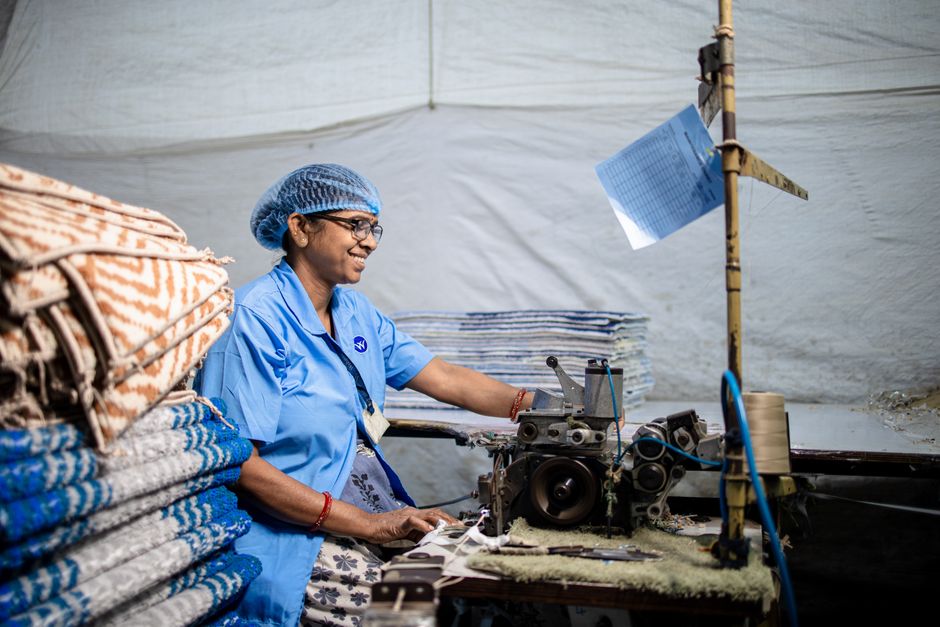
Real sustainability isn't a capsule collection or a carefully worded press release. It's a business model. It's in the decisions a brand makes before it sells a single item: what fabric it uses, how it manages production volume, who makes the clothes and under what conditions, and whether waste is built into the system from the start.
At ANAHIV, everything is made to order — which means no excess inventory, no unsold stock heading to landfill, and no overproduction. Every linen dress or linen co-ord is created only when a real customer wants it. Linen itself is a fabric with genuine environmental credentials — it requires less water and fewer pesticides than conventional cotton, and it biodegrades naturally. These aren't marketing claims layered over a conventional fast-fashion operation; they're structural choices baked into how the brand works.
Sustainability that's real doesn't need elaborate vocabulary to dress it up. It shows up in the way a brand operates every day — in its lead times, its fabrics, its refusal to hold surplus stock, and its relationship with the people who make its clothes.
The Simplest Question You Can Ask
Next time a brand tells you it's sustainable, ask one question: What would you have to change about your business model if you genuinely believed that? The answer — or the absence of one — will tell you everything.
Greenwashing thrives on shoppers who are too busy or too overwhelmed to dig deeper. The good news is that regulators, journalists, and a growing community of informed consumers are making it increasingly difficult to hide. The era of unchecked environmental marketing, as one legal analysis put it, is officially coming to an end.